
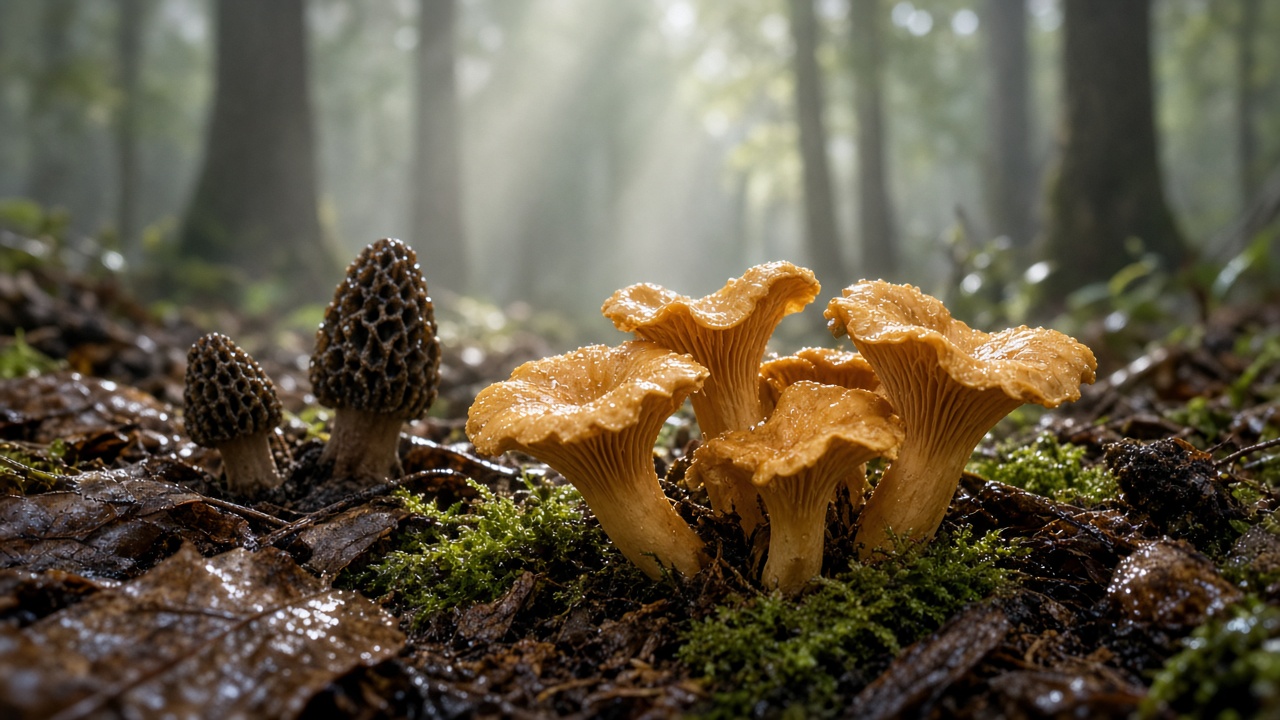
If you hunt mushrooms, you already know that the key question determinine if you’ll find them isn’t “will it rain this afternoon”. Fruiting is driven by how much water reached the ground, how long the soil stayed wet, and whether the soil itself is in the right temperature window. Precip is built for those questions at the exact patches you hunt, not the nearest airport.
Rain soaks the ground. Then mushrooms fruit.
Mycelium is already in the wood or soil. A flush is the reproductive response to moisture. A useful rule of thumb:
- A soaking rain that actually wets the duff and upper soil is what matters. A brief shower on dry ground often does nothing.
- Many edible species show two to five days after that rain, not the same morning.
- Look at multi-day totals (48 hours and 7 days), not only the last 24 hours. One wet day after a dry week is a different hunt than a week of repeated rain.
- Soil moisture is the leftover of that rain. If the ground has already dried out, the window may have closed even if last Tuesday was soaked.
Airport gauges miss woods. Ridges, hollows, and the far side of a county often get different totals. Precip’s rainfall map and last-n totals (12 hours through 7 days) are estimates at roughly 1 km, so you can see whether your stand actually got the rain.
The recent rain view is especially useful: it shows the last real event, how much fell, and when it ended. That is the clock most foragers should be watching.
Soil temperature sets the season
Air temperature on a forecast is a poor proxy. The mycelium lives in the litter and the top few inches of soil.
Typical windows foragers use (soil, not air):
- Morels: often when 4-inch soil temperatures sit around 50–55°F and are rising in spring.
- Chanterelles and other summer species: warm, stable soil after humid rains, commonly in the upper 50s to 70s °F.
- Fall species (hen of the woods, many boletes): fruit as soils cool from summer highs, still after moisture.
Those numbers are species- and region-specific. The useful habit is the same: know the soil temperature at the patch, then watch for rain that lands while it is in range.
Precip’s soil temperature layers report 0–10 cm and 10–40 cm, updated hourly. The shallow layer is the one that matches most mushroom fruiting. Pair it with soil moisture if you want to see whether that rain is still in the ground.
Check the woods you actually walk
Save each hunting spot as a location. From there you can, without guessing from town:
- Read how much rain fell over 24 hours, 48 hours, and 7 days.
- See when it last rained and how large that event was.
- Check soil temperature at 0–10 cm.
- Confirm soil moisture so you are not driving to a stand that has already dried.
- Set a rain or temperature threshold alert so you hear about a soak instead of refreshing the map.
The same location page works on your phone in the parking lot. Drop a pin on a new hollow, save it, and it becomes another patch you can compare.
Bonus: stay dry on the hunt
Rain that already fell is what grows the mushrooms. Rain that is about to hit you is just an uncomfotable hike back to the car. Turn on Precip’s incoming rain alert and you get a push when a shower is moving toward your current location with enough lead time to bag what you have, and walk out before it starts.
Generic weather apps optimize for cities and “will I need a jacket.” Foraging needs rain that already happened, soil that is still wet, and soil temperature at the woods. Precip gives you both.